A utility room is rarely designed so much as left over. You inherit a narrow slot off the kitchen, a washing machine, a boiler and everything that would not fit anywhere else. The good news is that small rooms respond well to ruthless zoning. Decide what you actually do in there — wash, dry, store the cleaning kit — and the clutter starts to sort itself out.
Measure before you buy anything
Ten minutes with a tape measure saves a wasted trip to the shops. Note the width and length of the room, the ceiling height, which way the door swings, and the position of every socket, pipe, stopcock and vent. Add the depth of each appliance: a standard washing machine is roughly 60cm square, but counter-depth models are shallower, and that difference decides whether a shelf will fit above it.
Then empty the room. Most small utility rooms are storing three half-used bottles of the same floor cleaner and a bucket with a split handle. Bin what has gone off, move the duplicates to where you will really use them, and you will have freed up more space than any storage system can create.
Split the room into three zones
Zoning is simply grouping things by the job they belong to, so you stop carrying a mop across the room to reach the detergent. In a room two metres by one and a half, the zones will not be separate areas — they run along the same wall and stack upwards. That is fine. What matters is that each job has a home.
Washing zone
This is the machine plus everything that feeds it. Keep detergent and conditioner within arm's reach of the door, ideally on a shelf or in a shallow tray at waist height, so spills are contained and easy to wipe. Store bulk refills high up or at floor level, never in the middle where they block your working space. A small lidded bin beside the machine gives lint, empty pods and dryer sheets somewhere to go other than the worktop.
Drying zone
Air does most of the work, so give it room. If you have height above the machine, a ceiling-mounted pulley or retractable line uses the warmth rising off the appliance and costs nothing to run. Where ceiling space is tight, a wall-mounted rack that folds flat is the neatest option; it looks like nothing when it is not in use. If a tumble dryer shares the footprint, stacking it on the washing machine is possible with a proper stacking kit — check the manufacturer's instructions for both appliances first, and never simply perch one on top of the other.
Ventilation matters too. Keep a gap behind a condenser dryer, do not box it in, and clear the lint filter after every load. A clogged filter is the most common reason a dryer turns slow and costly to run.
Cleaning and storage zone
This is the zone that causes most of the mess: mop, bucket, vacuum, broom, cloths and sprays. A tall narrow cupboard is ideal, but a strip of wall works nearly as well. Fit a hook rail for long handles and a bracket at the base to hold them upright so they do not lean on the walls. Keep cloths, sponges and spare bin bags in a basket you can lift out in one movement. Cleaning products belong together and out of reach of children and pets — a high shelf, a latched cupboard or a lidded box.
Shelving that earns its place
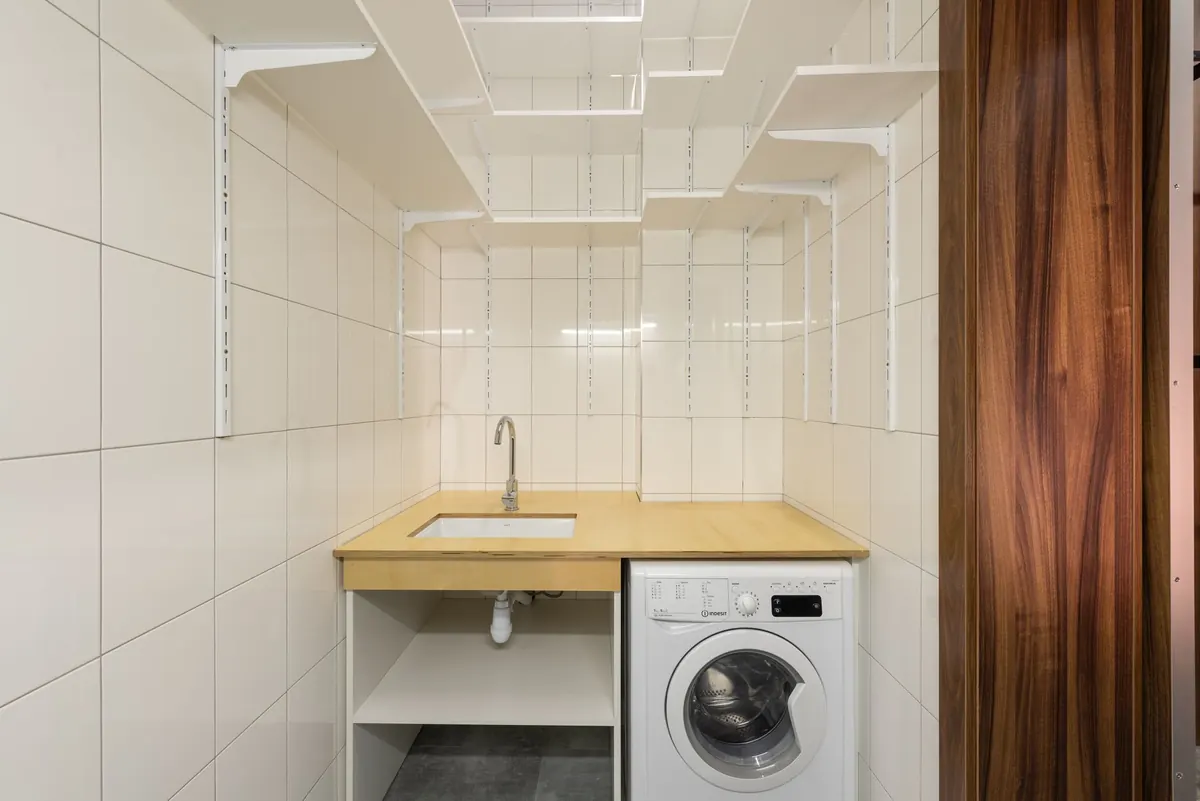
Depth is where utility room shelving usually goes wrong. In a narrow room, a 40cm shelf becomes a black hole: things go in and never come out again. Around 25 to 30cm is plenty for bottles, boxes and baskets, and anything deeper is better served by a pull-out basket.
Measure the shelf, then buy the container. Doing it the other way round is how you end up with gaps and wobbling stacks.
As a rough guide, a worktop-height surface over the machine gives you somewhere to fold and sort. A shelf about 18cm above that takes standard bottles. A high shelf near the ceiling takes bulk packs and the things you need twice a year. Loaded shelves are heavy, so fix into studs or use proper cavity fixings rather than whatever screws happen to be in the tin. If the walls are hollow plasterboard, a freestanding unit may be the safer answer.
Baskets, boxes and labels
Containers stop small items spreading. Choose by job rather than by looks:
- A tall lidded basket for dirty laundry, kept where you naturally drop clothes.
- A shallow tray for cloths and sponges, so they dry instead of sitting damp in a heap.
- A lidded box for spare bulbs, batteries and fuses.
- A caddy with a handle for the sprays and cloths you carry from room to room.
- A small tin for the odds and ends that come out of pockets.
Label anything you cannot see into, writing on the side that faces out. Clear containers earn their place for things you need to identify quickly; opaque ones suit clutter you would rather not look at.
Use the awkward spaces
- Behind the door. An over-door rack holds cloths and brushes, as long as the door does not swing into a shelf.
- Beside the machine. A slim trolley 15 to 20cm wide turns a dead gap into storage for bottles and cloths.
- Above the door. Where there is clearance, a shelf here takes light, rarely used items.
- Under the worktop. Stackable drawers use the height better than one deep cupboard.
A five-minute weekly reset
Small rooms only stay organised with a light, regular reset. Once a week, empty the lint bin, restock the cloths basket, return stray tools to their homes and wipe the shelf under the detergent. Once a season, look at the bulk stash and pull out anything you have not touched. Nothing elaborate — the point is that tidying takes minutes rather than an afternoon.
Where to start
Begin with the washing zone. Clear the top of the machine, put one shelf and one basket within easy reach, and give the detergent a fixed home. Live with it for a week before buying anything else; you will quickly learn what you reach for and what just sits there. Then repeat the exercise for drying, and finally for the cleaning kit. Three small improvements in a small room add up to a room that works.
One last note: if you are adding sockets, moving a vent or rewiring anything in a room with water and appliances, use a qualified electrician rather than adapting what is already there.
Photo: Max Vakhtbovych / Pexels